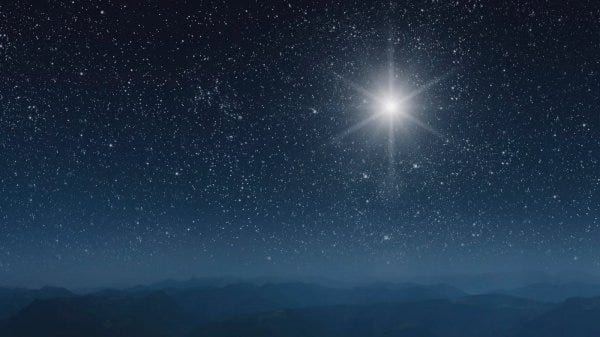
The Light That Guided Seekers

In the ancient lands east of Judea, where the vast Persian Empire stretched under endless skies, lived three wise men known as the Magi. They were not kings, but scholars — astrologers and astronomers who spent their nights charting the movements of the heavens, believing that the stars whispered secrets of kings and kingdoms.
One crisp evening in the spring of what we now call 5 BC, the eldest Magi, Melchior, gazed upward as he often did. Suddenly, a new light appeared in the eastern sky — a brilliant object with a sweeping tail, like a broom sweeping across the stars. It was no ordinary star; it moved slowly against the fixed backdrop of the constellations, lingering in the same region for over seventy days. The ancient Chinese scribes far away would later record it as a “broom star,” but to the Magi, it was a divine portent.
”This is no mere comet,” Melchior declared to his companions, Gaspar and Balthazar, as they gathered in their observatory tower. “Comets often herald doom, but this one shines with purpose. Look how it rises in the east, in the direction of Judea. The ancient prophecies speak of a star that shall come out of Jacob—a king born to rule the nations.”
The others consulted their scrolls and star charts. In their tradition, such celestial signs announced the birth of great rulers. This bright wanderer, appearing in the constellation associated with kingship, seemed to proclaim the arrival of a mighty one: the King of the Jews. Excitement stirred in their hearts. They had waited for such a sign, and now the heavens themselves called them to action.
Packing gifts fit for royalty — gold for a king’s crown, frankincense for divine worship, and myrrh for the sacred anointing — they set out on a long journey westward, following the light that beckoned from afar. Camels laden with provisions trudged across deserts and mountains, guided by the comet’s glow in the predawn sky.
Months passed. The comet faded, but the Magi’s resolve did not. They arrived in Jerusalem, the grand capital, expecting to find celebrations for a newborn prince. Instead, they found unease. King Herod, paranoid and ruthless, summoned them secretly.
”Where is this child born king of the Jews?” he demanded, his voice laced with false curiosity. “We saw his star when it rose in the east and have come to pay homage.”
Herod’s advisors scrambled through prophecies, whispering of Bethlehem, a small village south of the city. “Go there,” Herod instructed with a sly smile, “and report back to me, so I too may worship him.”
As the Magi departed Jerusalem toward Bethlehem, something wondrous happened. The comet, now visible again in its orbital path, appeared to move ahead of them in the southern sky. From their vantage, it seemed to pause — its motion aligning perfectly with the road southward, as if standing still over the humble town below. In truth, it was the Earth’s own turning that created this illusion, but to the travelers, it felt like divine guidance, leading them precisely to their destination.
At last, in a simple house, they found the child — a toddler now, with his young mother Mary and protector Joseph. Overwhelmed with joy, the Magi knelt, offering their treasures. The gold gleamed, the frankincense filled the air with sweet smoke, and the myrrh spoke of deeper mysteries yet to unfold.
That night, warned in dreams of Herod’s treacherous intent, they slipped away by another route, returning home with stories of a light that was no accident of the cosmos, but a beacon from the Creator Himself.
And so, the Star of Bethlehem — not a fixed star, but a wandering comet sent across the heavens — fulfilled its purpose. It bridged worlds, drawing seekers from afar to witness the birth of hope, reminding all who look up that the skies declare truths far greater than we imagine: a King had come, not in power, but in humility, to light the way for every seeking heart.
Merry Christmas! May the wonder of that ancient light inspire you still.